
What is plagiarism?
Before we dive in, let’s discuss what plagiarism is. The general idea of plagiarism is that it’s the process or act of stealing another person’s work or ideas and passing them off as your own. You might be wondering, “but what does that mean really?”
Merriam Webster tells us the origin of the word plagiarism, as found on https://www.merriam-webster.com/dictionary/plagiarism: The root of plagiarism comes from the Latin word plagiarius which means “kidnapper.”
Here’s an example:
Let’s say you are asked to write a paper about George Washington and you find a great source about his life, accomplishments, and contribution to the United States Government. Instead of writing it in your own words, you decide to just change a word or two from sentences you found in the articles you read without citing (referencing) where you got the information. This is a classic example of plagiarism. You are taking information that isn’t common knowledge and acting as if you wrote it. This is bad!
So, how do you avoid plagiarism?
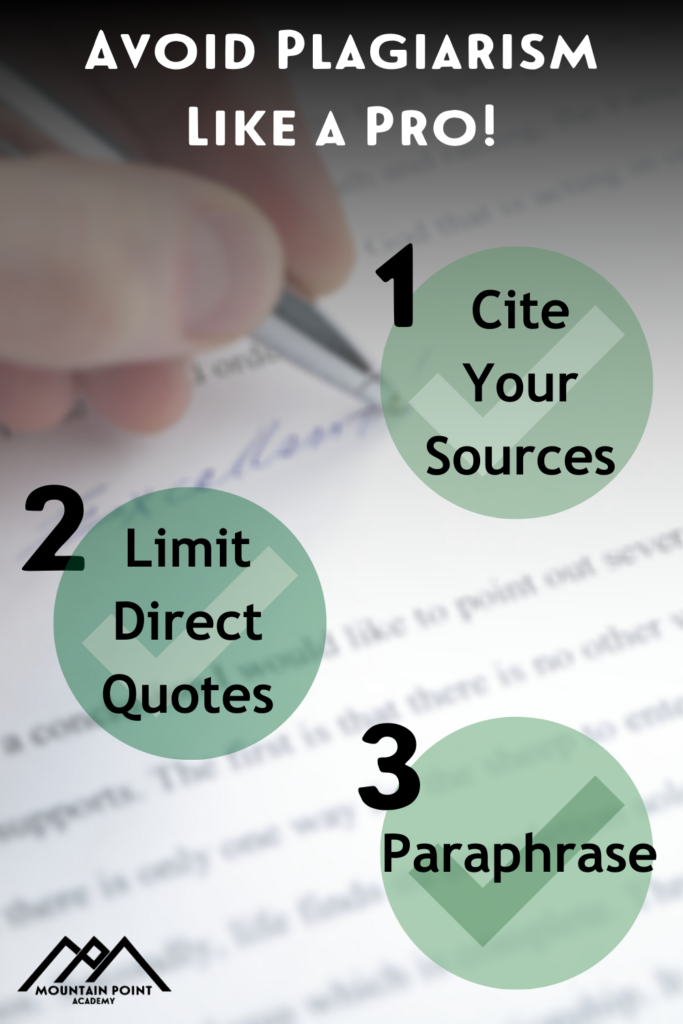
1. Cite your sources
There are several styles for citing your sources throughout a paper and on a Works Cited page, but the most popular for academic papers is either MLA or APA style. For more information, you can check out the OWL Purdue Writing Lab as they are a great resource for familiarizing yourself with the styles. They have several helpful resources here:
As you learn more about the process of writing and avoiding plagiarism, you will run into instances where you aren’t sure if you should give credit. The rule of thumb here is “better safe than sorry.” If you aren’t sure if the information is “common knowledge” or if you should give credit, be sure to give credit to avoid any instances of plagiarism.
2. Limit direct quotes
Make sure when writing a paper, at least 90% of your paper is your original words. You can use quotes and other paraphrased information from outside sources, but you MUST be sure to give credit to the sources to avoid plagiarism. A good rule of thumb is to always paraphrase whenever possible. If it is very important for your readers to be able to see the original text, or if the original author stated the information in the perfect way that you cannot capture by rephrasing it, then use a direct quote. However, if using a direct quote doesn’t add value to your paper, your readers (including your teacher) will want to read YOUR analysis of the information rather than the original author’s words.
3. Paraphrase
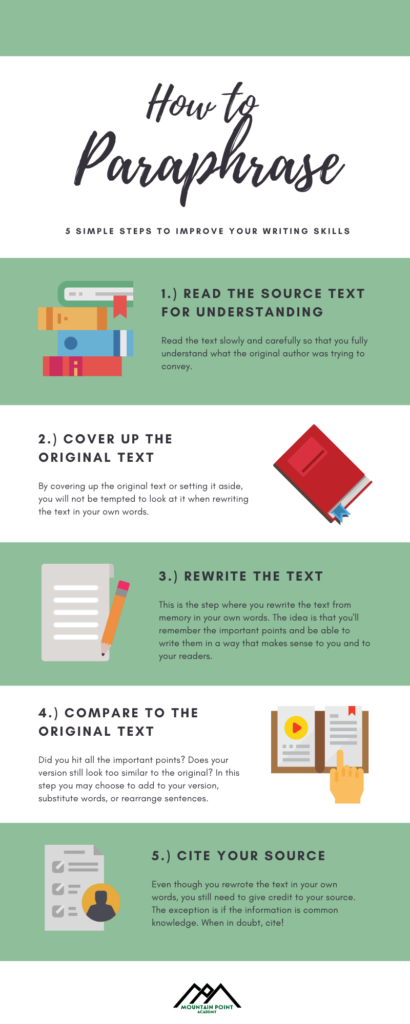
This does NOT mean you simply change a word or two. This means you try to take an idea you read about and put it into your own words without looking at the original work. The question then becomes: do I still have to give credit if I have paraphrased someone’s work and the answer is YES! If the idea isn’t yours or isn’t “common knowledge”, then you need to give credit even when paraphrasing. By following these 5 simple steps, you’ll master the art of paraphrasing:
- Read the source text for understanding
- Cover up the original text
- Rewrite the text
- Compare to the original text
- Cite your source
What is the penalty for plagiarism?
Plagiarism is a serious academic offense that could result in you failing a course, so it’s something that shouldn’t be taken lightly. You may think this is innocent because the information is already out there, but it’s not a victimless crime. Plagiarism is stealing.
To make the connection a little more personal, imagine that you wrote an epic play with amazing characters, a great storyline, and creative dialogue. Imagine someone you don’t know obtains a copy before it’s released to the general public and passes it off as their work, moving on to make millions because the play is a smash hit. How would you feel? Would you feel violated? Would you feel some sense of injustice?
This is why plagiarism is a serious violation. Taking ownership for someone else’s ideas is morally indecent. Great ideas are presented by others and it’s okay to reference them, but you must always be sure to give credit where credit is due.
Plagiarism not only holds true in an academic setting, but also in a professional workplace. It is important that in the workforce, you also avoid plagiarizing since that is also a serious violation that could lead to your termination from employment.
Learning how to avoid plagiarism now will benefit you throughout your academic and professional career.
If you have any questions about plagiarism, comment below and we can help answer it for you!
Keep working hard!
Anjilee & Sara