
Your teacher just assigned a research project and you need to find 5-7 reliable sources. Where do you start? This guide will walk you through the process of determining if a source is reliable, deciding what type of sources you need, and identifying red flags to spot commonly unreliable sources.
Why do I need to find reliable sources?
Part of maintaining academic integrity involves finding and using reliable sources to complete research papers, essays, and projects. In an age of abundant digital information, fake news and biased research is prevalent now more than ever. Your readers are expecting you to provide accurate and trustworthy information in your work and back it up with evidence. Starting with a reliable source is a great way to make sure the information you are providing in your project or paper is credible and not misleading to others. Providing false or misleading information, whether on purpose or by accident, violates the principles of academic integrity and you should take all measures necessary to ensure you are providing accurate and up-to-date information to your readers.
How do I determine if a source is reliable?
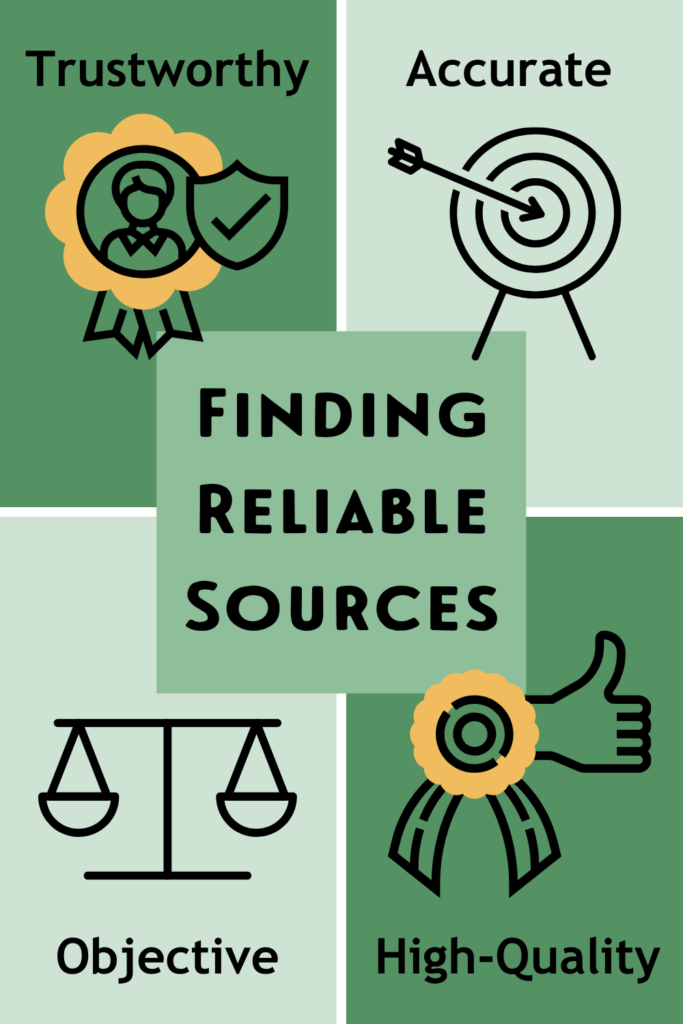
Now that we’ve answered the question on why reliable sources are important, we need to learn how to determine if a source is reliable or not. When determining the reliability of a source, we need to make sure it is trustworthy, accurate, objective, and high-quality. Keep the following things in mind when reviewing a source:
Type of Source
Sources can be found in various media formats and on different platforms. You may have found your source in an academic journal or a database of scholarly articles. On the other hand, you may have found your source from an ad-filled website or social media post. Where you found your source can tell you a lot about its credibility. Also, know the difference between primary and secondary sources and determine which type best suits the needs of your paper or project.
- Primary source: First-hand accounts from the source itself (ex. Photographs, newspaper articles, videos, original research, or survey data)
- Secondary source: Uses primary sources, but quotes the original source through generalizations, adding in their own interpretation of the primary source (ex. Documentaries, books about a topic, or analysis of data)
(For additional information on primary vs. secondary sources,
you can click here for a good resource from UMass Boston)
Author
Take a closer look at the author and publisher of the source. Are they an expert in their field? What type of experience and education do they have? What are their credentials? It’s never a bad idea to do additional research on the author of the source to take a look at other works they’ve written and who they might be endorsed by.
Agenda
What is the purpose of the source? Is the purpose to educate readers or viewers, or is the purpose to persuade or sell a product? Maybe the author is writing an article for entertainment purposes or as “clickbait” to drive more traffic to a website. Be aware of any potential bias that might be present in the source. Knowing the point-of-view of the writer will help determine accuracy and reliability of the information.
Date of Publication
Depending on the type of information you are looking for, you may want to use sources that are more recent and up-to-date, or you may want older sources that are from firsthand accounts. Generally speaking, it is a good idea to use the most recent studies and findings whenever possible.
Sources Used
Look at the references used by the author. Are they quality sources? High-quality sources will cite all the sources they used in their research. If those sources are not credible or are few in number, you may want to do additional research on your own to determine the reliability of that particular source.
Where do I find reliable sources?
First, ask yourself what your goal is in your writing. What type of information do you need to accomplish the purpose of your paper? Are you writing a scientific research paper or are you writing an opinion piece that analyzes two sides to an argument? Making sure that the sources you choose are not only reliable but relevant is an important step in the research process. The University of Arkansas – Sam M. Walton College of Business created a great list of sources to consider when conducting your research. We’ve listed some of those sources below:
- Peer-reviewed journal articles (reliable)
- Almanacs (reliable)
- Encyclopedias (reliable)
- Books (potentially reliable – check credibility using above tips)
- Newspaper articles (potentially reliable – watch out for opinion editorials)
- Websites (potentially reliable – check credibility using above tips)
- Interviews (potentially reliable – check credibility using above tips)
- Magazine articles (typically unreliable unless scholarly magazine)
What are some commonly unreliable sources?
Wikipedia, ads, social media, and certain magazine articles are commonly unreliable sources.
While Wikipedia is a good place to kick-start your research, using it in and of itself is typically not reliable. Wikipedia is a website that gives free information to its readers, who also collaborate together to make edits. The editors of the site are volunteers like you and me, and while most are well-meaning, some may purposely inject false information. Regardless of intent, false information can sometimes find its way into Wikipedia articles, which is why you must always check the sources. For this reason, it’s better to use Wikipedia as a “jumping-off point” rather than as an official source and use the references listed at the bottom of Wikipedia articles to further your research.
Ads, magazine articles, and social media posts typically have an agenda or are filled with bias. Advertisements exist to sell a product or service. The main goal is not to provide you with unbiased information, but to sell to you. Magazine articles are often biased or written for the purpose of entertainment. They are often opinion articles and do not typically include scholarly information. Social media is another place to find articles that are either filled with bias or opinion and only circulated as “clickbait” to drive more traffic to a website. Look out for titles that grab your attention by appealing to your curiosity or emotion in order to draw you in and click on a link.
We hope you found this article helpful for you as you move forward to find reliable sources for any academic papers you will be writing in the future.
Good luck!
Anjilee & Sara
—————————————————————————————————————————
Resources
https://umb.libguides.com/PrimarySources/secondary
https://sites.umgc.edu/library/libhow/credibility.cfm
https://www.uopeople.edu/blog/ultimate-student-guide-to-finding-credible-sources